
Conformal Coating Machine Settings Used by Variable Frequency Drive Manufacturers Protecting Compact Inverters

On the circuit board of a modern drive, conductors carrying hundreds of volts sit a fraction of a millimetre away from control traces that work at a few volts. Moisture, conductive dust and corrosive gases can bridge those gaps.
A thin polymer film, the conformal coating, is the usual defence, and the settings of the machine that applies it determine whether the film actually reaches every critical point. In a compact inverter, with components packed tightly and little airflow, those settings carry extra weight, and a variable frequency drive manufacturer has to tune them to each board layout.
Why Dense Drive Boards Need a Protective Film
When a cold drive meets warm, humid morning air, moisture condenses across its circuit boards. Dust containing salts or metal particles settles between pins in the same way, and leakage currents, followed in time by surface tracking, can develop along the board. Corrosion of fine-pitch component leads follows the same path, especially in agricultural, coastal or chemical environments.
A compact inverter concentrates these risks, because miniaturisation reduces the spacing between conductors and leaves little room for wider creepage paths. A coating raises the insulation resistance of the board surface and keeps contaminants away from the copper, so the electronics tolerate conditions that would otherwise cause intermittent faults.
Materials and Application Methods
Coating chemistries differ in how they balance protection, temperature tolerance and repairability. Acrylic coatings are easy to apply and to remove for repair, silicones tolerate higher temperatures and remain flexible, polyurethanes resist chemicals and abrasion, and vapour-deposited parylene forms a very thin, uniform layer at a higher process cost. The right choice depends on the operating environment and on whether boards will ever be reworked in service.
Application methods range from brushing and dipping to automated selective coating, in which a robot carries one or more valves over the board along a programmed path. Selective coating dominates volume production because it places material only where it is wanted and leaves connectors, test points and heat-transfer surfaces clean without extensive masking. A variable frequency drive manufacturer with many board variants tends to favour this method, since every layout can be stored as its own program.
The Machine Settings That Define Film Quality
How much material leaves the valve is set by the fluid itself: its viscosity, its temperature and the supply pressure behind it. Valve settings include the choice between atomised spray, film and needle dispensing, the atomising air pressure where relevant, and the height of the nozzle above the board.
Motion settings define travel speed, path overlap, tilt angle for reaching the sides of tall components and the number of passes, while curing settings, whether air-dry, heat or UV with a secondary moisture cure for shadowed areas, determine when the film reaches its final properties.
Mistakes in these settings appear as thin spots on component edges, bubbles under tall parts, or coating creeping into connectors where it blocks contact. Recipes are developed board by board, and a variable frequency drive manufacturer rarely publishes them; FRECON, for example, describes the coating on its FR01 by function, stating that the enhanced conformal coating protects against moisture, corrosion and dust. For a general-purpose inverter, the practical evidence of a sound recipe is stable operation within the conditions the datasheet allows, not the recipe itself.
Inspection, Rework and the Limits of Coating
Most coatings carry a fluorescent tracer, so boards are inspected under ultraviolet light, where uncovered areas, thin edges and splashes stand out. Film thickness is checked on test coupons or with measurement gauges, and some lines add automated optical inspection at the same step. Boards that fail are stripped locally and recoated, a task that is easier with acrylic than with harder chemistries.
Coating also has clear limits. It does not make an open enclosure waterproof, it cannot cope with liquid water standing on a board, and it adds a slight barrier to heat leaving small components.
FRECON presents the FR01 as running stably in dusty, humid or high-temperature settings, yet the series still specifies indoor operation away from water droplets, oil mist, salt and corrosive gases, with an ambient range of −10 to 40°C and derating above 40°C. A general-purpose inverter relies on coating, enclosure and installation together, and none of the three can replace the others.
Coating in the Context of a Compact Drive
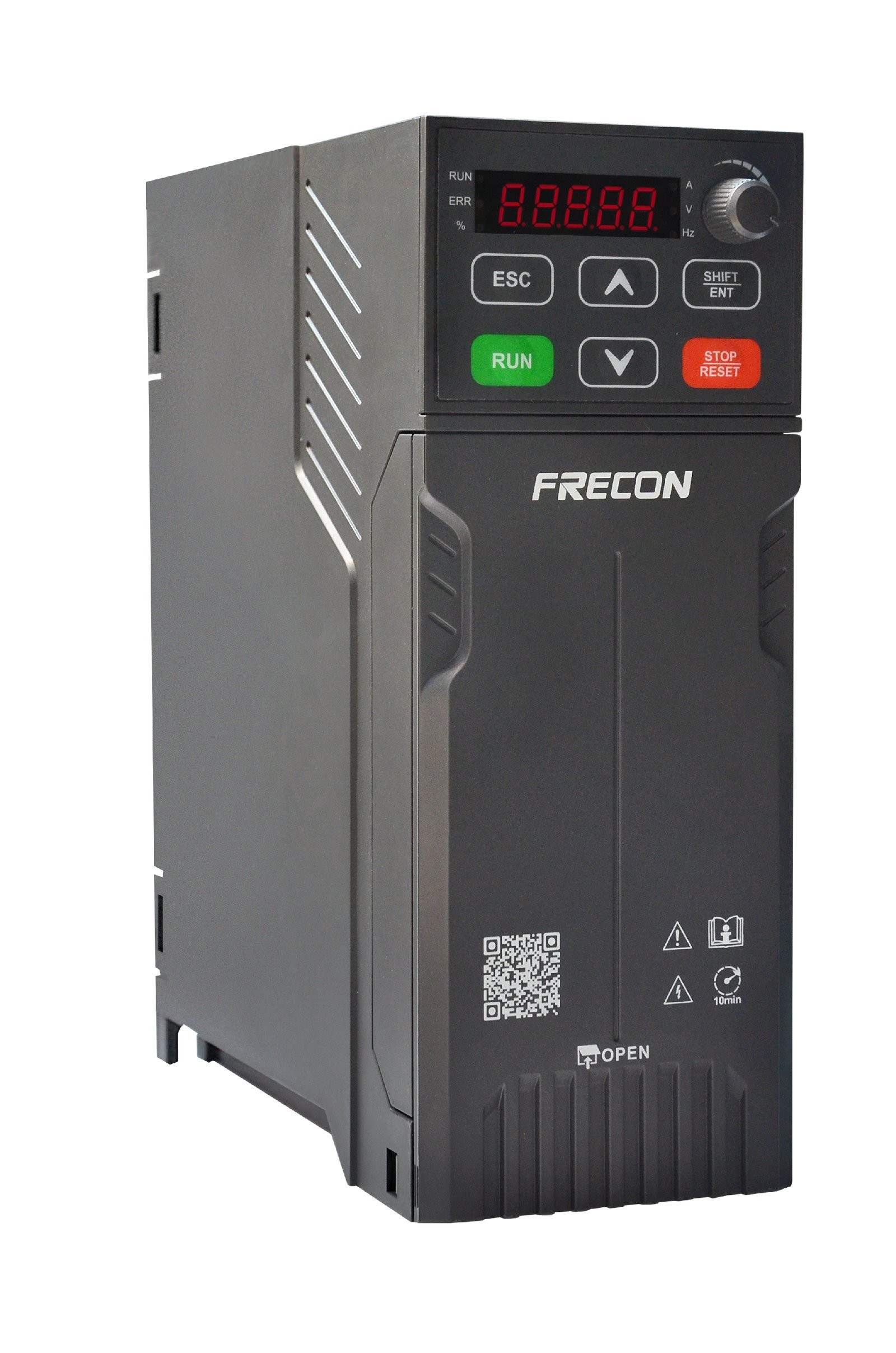
Coating becomes one of several design choices once a drive is made small. FRECON’s FR01 smart inverter combines the enhanced coating with a narrow book-style body, standard DIN-rail mounting, zero-spacing side-by-side installation and an independent air duct.
Its single-phase 220V models cover 0.4–4 kW and its three-phase 380V models 0.37–7.5 kW, in three enclosure sizes ranging from 65 × 170 × 140 mm to 90 × 245 × 165 mm.
The FR01 sits within a general-purpose inverter range that also includes the FR150A, FR30, FR500A/FR510A, FR600, FR380 and FR20 series. The coating recipe of a compact inverter in that range stays invisible to the user, yet it shapes how the drive copes with a damp pump room or a dusty woodworking shop. On a small board, the narrowest gap on the densest layout is the point around which every fluid, valve and motion setting is ultimately tuned.
