
PVC Pipe Making Machine Manufacturers: How Energy Efficiency Leadership Is Achieved and Demonstrated

Energy efficiency in PVC pipe production cannot be judged by electricity bills alone. Output volume, pipe dimensions, material formulation, production speed, and the amount of rejected material all affect how much energy is required to manufacture each meter of usable pipe. A line consuming more electricity per hour may still perform better if it produces substantially more compliant product with less waste.
To demonstrate energy performance, PVC pipe making machine manufacturers require consistent measurement methods, meaningful comparisons between equipment configurations, and records usable for customers’ sustainability reporting. The central question is not simply how much power a production line draws, but how efficiently that energy is converted into saleable output.
Establishing a Reliable Specific Energy Consumption Baseline
Specific energy consumption (SEC) provides a practical starting point for evaluating extrusion efficiency. It is generally expressed as kilowatt-hours per kilogram of output, or sometimes kilowatt-hours per meter of finished pipe when products have comparable dimensions. The mass-based calculation is particularly useful when pipe diameters or wall thicknesses differ, while a per-meter figure can help production teams assess the energy cost of a defined product. To make the result meaningful, the measurement must specify which equipment is included, such as the extruder, haul-off, vacuum calibration system, cooling equipment, and downstream cutting units.
A reliable test begins with a clearly defined operating condition. The material formulation, pipe specification, target line speed, and startup procedure should be documented before electricity use is recorded. Measurements taken during warm-up or frequent stoppages can distort a steady-state result, so startup energy and normal production energy are best tracked separately when the objective is to understand both operational efficiency and overall factory consumption. Output should be weighed or otherwise measured using a consistent method, with rejected pipe recorded separately rather than counted as usable production.
The calculation itself is straightforward: total electricity consumed during the defined test period is divided by the corresponding mass of conforming output. For example, a line that consumes 120 kWh while producing 600 kg of accepted pipe records an SEC of 0.20 kWh/kg. If 50 kg of that production is rejected, the calculation should use 550 kg of saleable output when assessing the energy burden of accepted product. Evaluating the performance of a PVC pipe manufacturing machine becomes easier when test duration, meter accuracy, product quality criteria, and excluded equipment are stated alongside the result.
Comparing Machines Under Equivalent Production Conditions
Comparisons between machines become unreliable when each supplier uses a different test setup. An extruder measured without its vacuum pump and cooling equipment may appear more efficient than a complete production line, even though the customer will operate the entire system. Fair evaluation requires a defined system boundary and equivalent product specifications. Where possible, comparisons should use the same PVC compound, pipe diameter, wall thickness, production length, and acceptance criteria. If identical conditions cannot be achieved, the differences need to be disclosed rather than concealed behind a single energy figure.
Production speed deserves particular attention because electricity demand and output do not always increase proportionally. Running a line slowly may reduce instantaneous power consumption, yet the energy required per kilogram can rise if fixed loads remain active while output falls. Conversely, increasing throughput beyond a stable processing range may raise motor demand, generate dimensional defects, or increase scrap. A meaningful assessment examines SEC alongside production rate, dimensional consistency, surface quality, and rejection percentage. These measures reveal whether a lower energy figure reflects genuine process improvement or simply a different operating point.
The comparison should also distinguish between equipment design and site-specific conditions. Heating requirements depend on the formulation and ambient temperature, while cooling loads can change with pipe dimensions, line speed, and water-system design. Older motors, poorly maintained bearings, leaking compressed-air systems, and inefficient pumps may influence the final result as much as the extruder itself. PVC pipe making machine manufacturers can make comparisons more useful by publishing the test conditions and identifying which energy-consuming components were included.
Using Equipment Design and Operating Data to Improve Efficiency
Energy savings often emerge from coordination across the production line rather than from one component in isolation. Extruder drive control can match motor operation to the required output, while appropriately sized heaters and effective thermal insulation reduce avoidable heat loss. Vacuum pumps, cooling pumps, and downstream drives also contribute to total demand. Their operating settings should reflect actual production requirements, since oversized equipment or unnecessary full-load operation can increase electricity use without improving pipe quality.
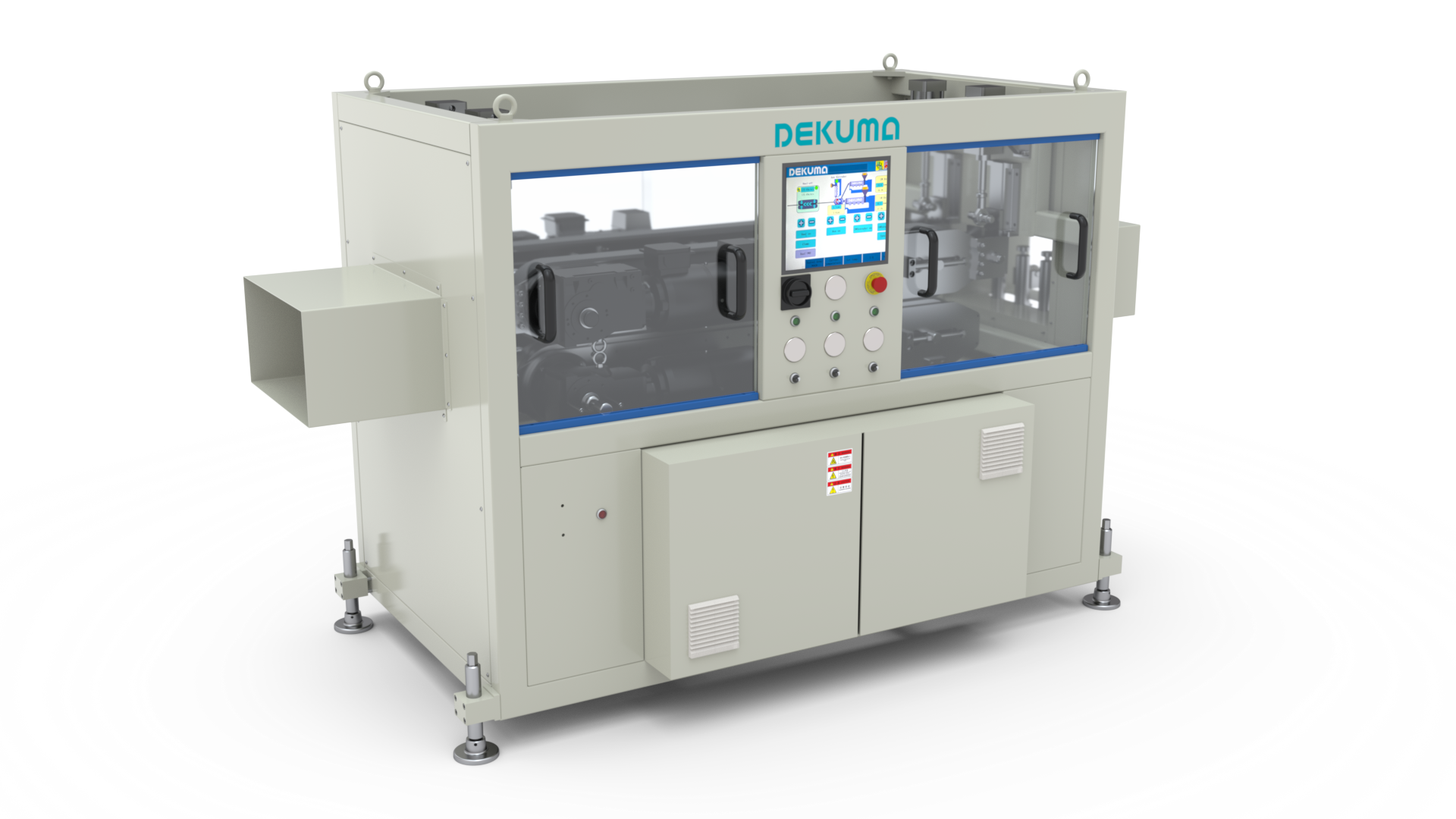
Material handling and downstream stability also influence energy performance. Irregular feeding can cause fluctuations in output, while unstable haul-off speed may affect dimensions and generate rejected lengths. A haul-off unit with synchronized caterpillar drive, adjustable clamping, and suitable traction can help maintain consistent movement through the line. DEKUMA offers haul-off configurations with an AC servo motor, pneumatic adjustment of the upper caterpillar, and electrically adjustable positioning for the lower caterpillar. Options with two, three, four, six, or eight caterpillars accommodate different production needs across pipe diameters from Ф20 to Ф450 mm. Such features support controlled transport, but their actual energy contribution must be established through measurements on the complete operating line.
Conclusion
A credible energy-efficiency claim rests on evidence that can be reproduced, compared, and interpreted in context. Specific energy consumption offers a useful benchmark, but its value depends on accurate output measurement, clearly stated system boundaries, and consistent product quality requirements. Comparisons between competing lines become more informative when operating conditions are disclosed and both electricity use and saleable output are considered.
PVC pipe manufacturing machine evaluations should also account for auxiliary equipment, scrap rates, and the practical conditions of sustained production. By supporting transparent testing and dependable operating records, PVC pipe making machine manufacturers can help customers make better-informed equipment decisions and report energy performance with greater confidence. DEKUMA‘s equipment is part of a production system whose overall efficiency is demonstrated through measured results, not specifications alone.
