
Maintaining precise altitude in indoor environments presents a unique set of challenges for unmanned aerial vehicle (UAV) operations. In confined spaces like automated warehouses or subterranean tunnels, traditional positioning systems such as GPS are often unavailable. Furthermore, barometric sensors, which rely on air pressure, can become unreliable due to localized drafts from HVAC systems or piston effects in narrow passages. To achieve stable drone hovering, professionals increasingly turn to advanced LiDAR technology to provide the high-frequency distance feedback necessary for flight controller adjustments.
Challenges of Confined Space Flight
The primary difficulty in indoor flight is the lack of a global coordinate system. Without GPS, a drone must rely on onboard sensors to perceive its environment in real time. In a warehouse setting, the presence of high-reaching racks and narrow aisles creates a complex 3D space where a minor drift in altitude can lead to a collision. Similarly, in tunnel inspections, uneven floor surfaces or debris can confuse traditional ultrasonic sensors.
A high-performance Benewake lidar solves these issues by providing absolute distance measurements to the ground or ceiling with centimeter-level precision. This data allows the flight controller to maintain a steady hover regardless of lighting conditions or air pressure fluctuations. For successful indoor operations, Benewake LiDAR can be integrated flexibly with UAVs in downward, forward, or bi-directional configurations to enable safe-distance flight from specific objects.
Best Practices for Stable Hovering
To optimize drone stability in these environments, several technical considerations should be followed:
Precision and Stability: Systems should utilize centimeter-level accuracy and integrate special rain and fog algorithms to avoid fuselage jitter and greatly reduce potential damage.
Addressing Endurance: Selecting ultra-lightweight designs, such as sensors weighing 1.35g, addresses endurance concerns and fits within the insufficient space typical of compact drone designs.
Quick System Setup: Utilizing plug-and-play testing with mainstream flight controllers reduces pre-deployment efforts and ensures rapid system integration.
Sensor Fusion: While LiDAR can operate standalone, combining it with optical flow sensors allows for even higher precision hovering at preset altitudes.
Product Recommendations for UAV Integration: The TFS20-L
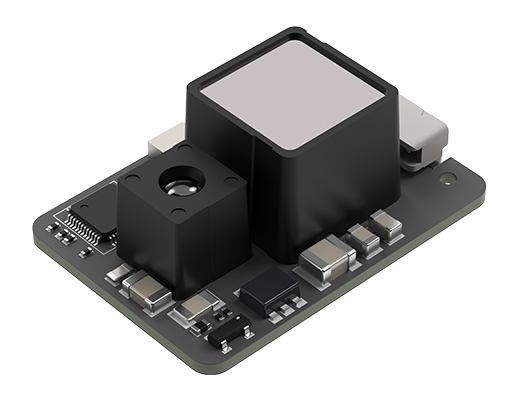
The TFS20-L is a fully integrated single-channel dToF ranging mini-module specifically designed for high-performance needs in a compact form factor. It incorporates a highly sensitive infrared-enhanced SPAD sensor and utilizes a histogram statistical algorithm to achieve high-precision distance measurements. This makes it an ideal Benewake lidar for modern UAV systems that require reliable data in a miniature package.
Compact and Lightweight Design: With physical dimensions of only 21mm * 15mm * 7.87mm and a total weight of 1.35g, it is an excellent choice for miniature dToF applications where space is at a premium and every gram of weight affects flight time and battery life.
Performance and Accuracy: The module offers a maximum operating range of up to 20m, providing sufficient headroom for most warehouse ceiling heights. It maintains an impressive accuracy of plus or minus 6cm. Furthermore, it features sunlight resistance of 15m even at 100Klux, making it versatile for various lighting conditions.
Seamless System Integration: Operating on a single 3.3V power supply with built-in temperature compensation, the TFS20-L supports both I2C and UART interfaces. This flexibility allows for easy integration into consumer drones, service robots, and custom industrial UAV platforms.
Strategic Implementation for Warehouse Logistics
In modern logistics centers, the implementation of drone hovering technology allows for automated shelf inspections and inventory management. By utilizing the TFS20-L, a drone can maintain a fixed altitude relative to the ground while moving horizontally along a rack. The centimeter-level precision ensures that the drone’s cameras or scanners remain perfectly aligned with the target items.
In tunnel environments, the dToF technology used in the TFS20-L is particularly effective. Because it relies on time-of-flight principles rather than light intensity, it remains stable even when flying over surfaces with varying reflectivity, such as wet tunnel floors or metallic pipes. The built-in temperature compensation ensures that as the drone moves between different climate zones within a facility, the ranging data remains consistent and reliable.
Technical Performance and Environmental Resistance
One of the most significant advantages of the TFS20-L is its ability to perform in high-ambient-light environments. Indoor warehouses often have areas of intense lighting near loading docks or under high-intensity discharge lamps. The 100Klux sunlight resistance of the TFS20-L ensures that the drone hovering performance is not degraded as the UAV moves from a dark corner into a brightly lit area.
The histogram statistical algorithm integrated into the module helps filter out optical noise, which is common in dusty industrial environments. This allows the drone to maintain a stable hover even if there is light dust in the air, a common occurrence in active distribution centers. By providing a stable and accurate distance to the ground at all times, the flight controller can make micro-adjustments to the motor speeds, resulting in a smooth and safe flight profile that protects both the equipment and the surrounding infrastructure.
About Benewake
Benewake (Beijing) Co., Ltd. is a global leader in the LiDAR industry, providing the “eyes” for a smarter, safer world through advanced Time-of-Flight technology. By delivering high-precision sensors that excel in both compact consumer builds and rugged industrial applications, the company enables machines to perceive their surroundings with unprecedented clarity. From warehouse automation to large-scale industrial infrastructure, Benewake is committed to pushing the boundaries of what is possible in optical sensing.
Precision is the foundation of autonomy. Do not let environmental complexity limit your operational potential—equip your fleet with Benewake’s market-proven LiDAR technology today and redefine the standards of indoor flight stability.


